


Understanding ED Glass: Why Ultra-Low Dispersion Matters for Scientific Observation
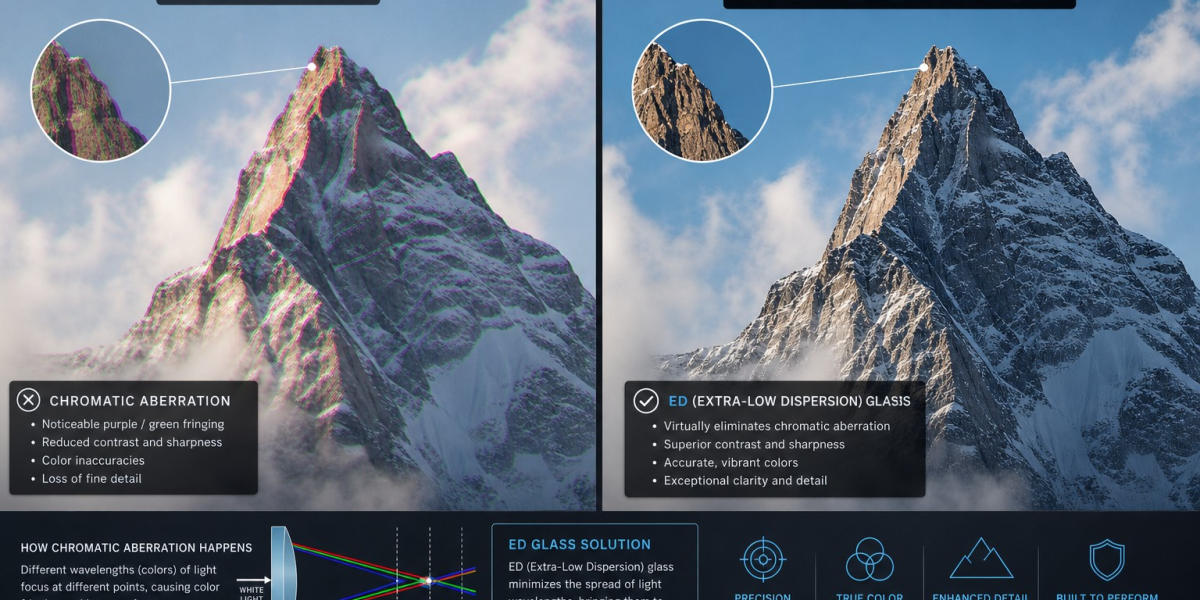
Understanding ED Glass: Why Ultra-Low Dispersion Matters for Scientific Observation
When observing distant subjects—whether it’s a rare bird in a dense forest or a celestial body in the night sky—image clarity is everything. The biggest enemy of high-magnification clarity is "chromatic aberration," often seen as a purple or green fringe around high-contrast edges. ED (Extra-low Dispersion) glass is a specialized type of optical glass designed to significantly reduce this color fringing by focusing all wavelengths of light onto the exact same focal plane.
The Physics of Clarity: How ED Glass Works
In a standard lens, different colors of light (wavelengths) travel through glass at different speeds and bend at different angles. This dispersion causes the colors to hit the sensor or your eye at slightly different points, resulting in a "soft" or blurry image with color leakage.
HYSPANDA’s ED Prime Glass utilizes rare-earth elements like fluorite to minimize this dispersion. By carefully controlling the refractive index, our lenses produce an image that is vibrant, high-contrast, and remarkably sharp from edge to edge.
Benefits for Scientific Observation and Wildlife Research
For professionals in field biology or environmental monitoring, the difference between standard glass and ED glass can be the difference between identifying a species and missing a discovery.
1. Accurate Color Reproduction
ED glass ensures that the colors you see through the lens are true to life. This is vital for researchers who rely on plumage or fur patterns for species identification.
2. Enhanced Contrast in Low Light
Because light is focused more efficiently, images appear brighter even during the "golden hours" of dawn and dusk when wildlife is most active.
3. Reduced Eye Strain
A clearer, sharper image is easier for the brain to process, allowing researchers to conduct long-duration observations without the fatigue associated with lower-quality optics.
Technical Comparison: Standard Glass vs. HYSPANDA ED Prime
| Performance Metric | Standard Optical Glass | HYSPANDA ED Prime Glass | | :--- | :--- | :--- | | Chromatic Aberration | Noticeable at high contrast | Virtually eliminated | | Light Transmission | 82% - 85% | >92% with Multi-Coating | | Edge-to-Edge Sharpness | Significant fall-off | Maintained across the FOV | | Resolution Power | Standard HD | Ultra-High Definition (UHD) |
FAQ: Understanding ED Optics
Q1: Is ED glass worth the extra investment?
| A clearer, sharper image is easier for the brain to process, allowing researchers to conduct long-duration observations without the fatigue associated with lower-quality optics. |
Technical Comparison: Standard Glass vs. HYSPANDA ED Prime
Performance MetricStandard Optical GlassHYSPANDA ED Prime GlassChromatic AberrationNoticeable at high contrastVirtually eliminatedLight Transmission82% - 85%>92% with Multi-CoatingEdge-to-Edge SharpnessSignificant fall-offMaintained across the FOVResolution PowerStandard HDUltra-High Definition (UHD)
FAQ: Understanding ED Optics
Q1: Is ED glass worth the extra investment?For any application requiring high magnification or professional photography, the improvement in image quality is substantial and immediately visible.
Q2: Does ED glass make the lens more fragile? While the glass chemistry is different, HYSPANDA protects its ED elements inside rugged, nitrogen-purged housings to ensure they are as durable as standard lenses.
Q3: Can I tell the difference between ED and standard glass with the naked eye? Yes. If you look at a dark object against a bright sky, standard glass will show a "halo" of color, while ED glass will show a clean, crisp edge.
Q4: Is "HD Glass" the same as "ED Glass"? Not necessarily. "HD" is often a marketing term, while "ED" refers to the actual physical properties of the glass material.
Q5: Which HYSPANDA products feature ED glass? All of our flagship observation systems and precision sporting scopes utilize ED Prime glass as a standard feature.
Conclusion: See the World with Scientific Precision
At HYSPANDA, we believe that high-end optics should serve as a bridge between the observer and the natural world. By utilizing ED glass, we provide scientific-grade tools that offer a window into the world with unparalleled clarity and accuracy.
--- Sources and References:
- Optical Physics Review: Dispersion Characteristics of Fluorite Lenses
- Wildlife Observation Association: Gear Standards for Field Research
- HYSPANDA Technical Whitepaper on ED Prime Glass Implementation (2026)